
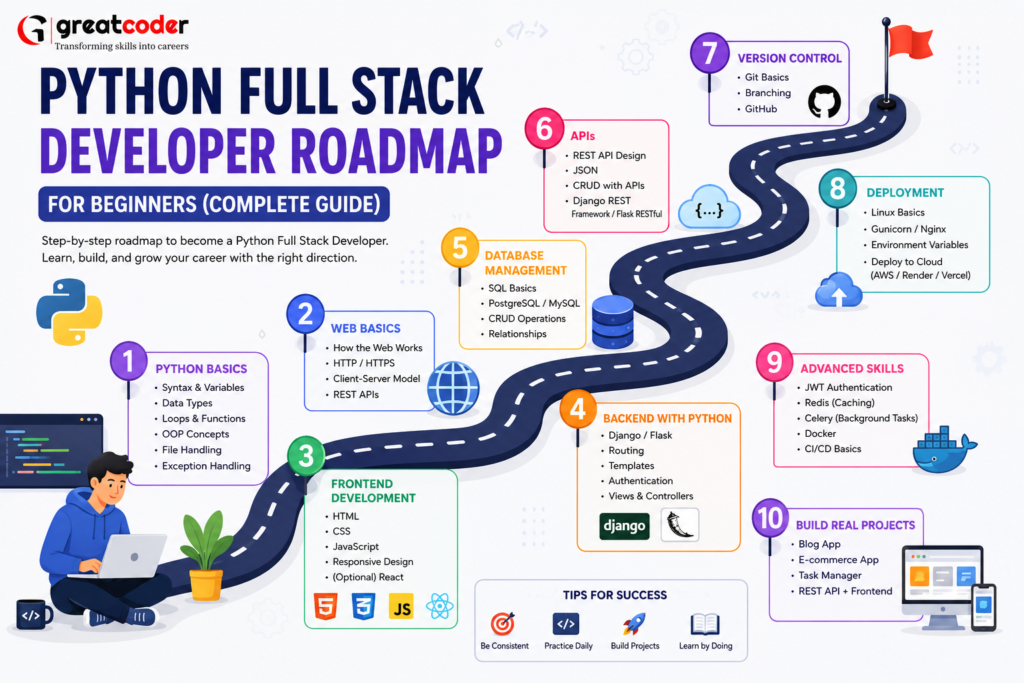
Python Full Stack Roadmap for Beginners
If you are searching for a Python full stack roadmap, you are likely confused about where to start and what to learn next.
Most beginners waste time jumping between random tutorials. That approach doesn’t work.
This guide gives you a clear, step-by-step path to become a Python Fullstack developer, with practical skills and real project direction.
Learn Python Basics
To become a Python developer, your foundation must be strong.
Focus on:
- Variables and data types
- Loops and conditions
- Functions
- Lists and dictionaries
- File handling
- Object-Oriented Programming (OOP)
Example:
def greet(name):
return f”Hello {name}”
print(greet(“krishna”))
What to build:
- Calculator
- To-do list (CLI-based)
Understand How the Web Works
Before backend development, understand the basics.
Learn:
- HTTP / HTTPS
- Client-server model
- Request and response cycle
- REST APIs
Without this, you will use frameworks blindly.
Learn Frontend Development
A Python full stack developer must know UI basics.
Start with:
- HTML
- CSS
- JavaScript
Build:
- Portfolio website
- Landing page
Optional:
- React (for modern frontend development)
Backend Development with Python
Now move into backend.
Choose one:
- Django (recommended for beginners)
- Flask
Learn:
- Routing
- Templates
- Forms
- Authentication
Example (Flask API):
from flask import Flask
app = Flask(__name__)
@app.route(‘/’)
def home():
return “Hello World”
app.run()
Step 5: Learn Databases
No application works without data storage.
Learn:
- SQL basics
- PostgreSQL or MySQL
Concepts:
- CRUD operations
- Joins
- Relationships
Build APIs
APIs are critical in modern applications.
Learn:
- REST API design
- JSON handling
Tools:
- Django REST Framework
- Flask RESTful
Project:
- Blog API
- User authentication API
Use Git and GitHub
Learn:
- Git basics
- Branching
- Pushing code to GitHub
Without Git, you are not job-ready.
Deployment
Most beginners stop before this step. That’s a mistake.
Learn:
- Hosting basics
- Linux commands
- Deployment tools
Platforms:
- AWS
- Render
- Vercel
Goal:
Deploy at least 2 projects live.
Build Real Projects
If you skip this, you won’t get hired.
Python projects for beginners:
- Blog application
- E-commerce mini project
- Task manager
- REST API with frontend
Each project should solve a real problem.
Advanced Skills
To stand out in the job market:
- JWT Authentication
- Docker
- Redis
- CI/CD basics
FAQs
How to become a Python developer from scratch?
Follow a structured roadmap, learn Python basics, build projects, and deploy them.
How long does it take to learn Python full stack?
With consistent effort, 6–8 months is realistic.
Which is better: Django or Flask?
Django is better for beginners due to structure and built-in features.
What are the best Python projects for beginners?
Blog app, task manager, and REST API-based applications.
Who Can Join
This course is designed for:
- Beginners with zero coding background
- Students who want to enter IT
- Graduates stuck in tutorial loops
- Working professionals switching careers
If you are serious about becoming a developer, you can start.
Conclusion
This Python Full Stack Developer Roadmap works if you follow it step by step.
Stop jumping between tutorials. Focus on one path, build real projects, and deploy them.
That’s how you become a Python developer.
If you’re looking for hands-on learning, you can explore a Python online training institute in Hyderabad that focuses on practical skills, portfolio building, and placement support.