
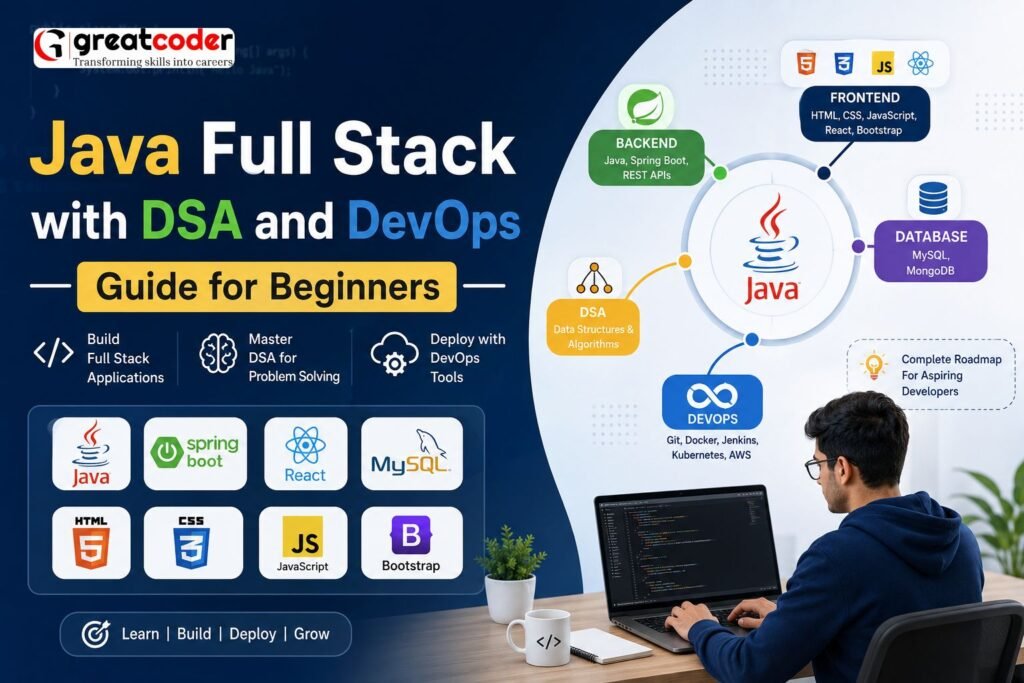
Java Full Stack with DSA and DevOps is one of the most in-demand career paths for beginners in 2026. This complete guide helps you learn frontend, backend, databases, DSA, cloud, and DevOps step by step.
The demand for Java Full Stack Developers continues to grow rapidly in 2026. Companies are not looking for developers who only know coding. They want professionals who can build complete applications, solve complex problems using Data Structures and Algorithms (DSA), and handle deployment using DevOps tools.
If you are a beginner and want to become a job-ready Java Full Stack Developer, this guide gives you a complete roadmap. You will learn what technologies to study, how to structure your learning, and how to build industry-level projects.
What is Java Full Stack Development?
Java Full Stack Development means building both frontend and backend applications using Java-based technologies along with modern web technologies.
A Java Full Stack Developer works on:
- Frontend UI development
- Backend APIs and business logic
- Database management
- Server deployment
- Testing and debugging
- Cloud and DevOps operations
A complete developer understands the full lifecycle of an application.
Why Learn Java Full Stack with DSA and DevOps?
Many beginners make a major mistake. They only learn frontend frameworks or backend coding and ignore DSA and DevOps.
That approach creates weak developers.
Companies now expect:
- Strong coding skills
- Problem-solving ability
- System understanding
- Deployment knowledge
- Cloud and automation basics
Learning Java Full Stack with DSA and DevOps makes you far more valuable in the job market.
Major Benefits
High Demand
Java is still one of the most used programming languages in enterprise applications.
Better Salary
Developers with DevOps and DSA knowledge often earn higher salaries.
More Career Opportunities
You can apply for:
- Full Stack Developer
- Java Developer
- Backend Engineer
- Software Engineer
- DevOps Engineer
- Cloud Engineer
Strong Problem-Solving Skills
DSA improves logical thinking and coding interview performance.
Industry-Ready Skill Set
DevOps knowledge helps you understand real-world software deployment.
Java Full Stack Roadmap for Beginners
Step 1 – Learn Core Java
Core Java is the foundation.
You must understand:
Java Basics
- Variables
- Data types
- Operators
- Loops
- Conditional statements
Object-Oriented Programming (OOPs)
- Classes and Objects
- Inheritance
- Polymorphism
- Abstraction
- Encapsulation
Advanced Java Concepts
- Exception handling
- Collections framework
- Multithreading
- File handling
- Streams API
- Lambda expressions
JDBC
Learn how Java connects with databases.
Step 2 – Learn DSA in Java
DSA is critical for coding interviews and problem-solving.
Important DSA Topics
Arrays
- Traversal
- Searching
- Sorting
Linked Lists
- Singly Linked List
- Doubly Linked List
Stacks and Queues
- Stack operations
- Queue implementation
Trees
- Binary Trees
- BST
- Tree Traversal
Graphs
- BFS
- DFS
- Shortest Path Algorithms
Recursion
Understand recursive problem-solving techniques.
Dynamic Programming
One of the most important interview topics.
Step 3 – Learn Frontend Development
Frontend development helps you build user interfaces.
HTML
Learn:
- Forms
- Tables
- Semantic tags
- Multimedia
CSS
Focus on:
- Flexbox
- Grid
- Responsive Design
- Animations
JavaScript
Learn:
- DOM manipulation
- Functions
- Events
- ES6 concepts
- Async programming
Frontend Frameworks
React.js
Most companies now prefer React for frontend development.
Learn:
- Components
- Props
- State
- Hooks
- Routing
- API integration
Step 4 – Learn Backend Development
Backend development is the heart of Java Full Stack.
Servlets and JSP
Understand basic web application flow.
Spring Framework
Spring is widely used in enterprise applications.
Important Spring Modules
- Spring Core
- Spring MVC
- Spring Boot
- Spring Security
- Spring Data JPA
REST APIs
Learn:
- GET APIs
- POST APIs
- PUT APIs
- DELETE APIs
Step 5 – Learn Database Management
Every application stores data.
SQL Databases
Learn:
- MySQL
- PostgreSQL
Topics to cover:
- Joins
- Queries
- Normalization
- Indexing
- Stored procedures
NoSQL Databases
Learn basics of:
- MongoDB
Step 6 – Learn Git and GitHub
Version control is mandatory.
Learn:
- Git commands
- Branching
- Merging
- Pull requests
- Repository management
GitHub helps you showcase projects to recruiters.
Step 7 – Learn DevOps for Beginners
Most beginners skip DevOps completely. That is a mistake.
Modern companies expect developers to understand deployment pipelines.
Linux Basics
Learn:
- File system
- Commands
- Permissions
- Package management
Maven and Gradle
These are build automation tools for Java projects.
Docker
Learn:
- Containers
- Docker images
- Dockerfile
- Docker Compose
Jenkins
Used for CI/CD pipelines.
Understand:
- Automated builds
- Automated deployment
Kubernetes
Basic container orchestration knowledge is valuable.
Cloud Platforms
Learn basics of:
- AWS
- Azure
- Google Cloud
Step 8 – Learn API Testing Tools
Testing APIs is important for backend development.
Popular Tools
- Postman
- Swagger
Step 9 – Build Real-Time Projects
Projects are more important than certificates.
Without projects, your resume looks weak.
Beginner Projects
Student Management System
Features:
- CRUD operations
- Database integration
Employee Management Portal
Features:
- Authentication
- REST APIs
E-Commerce Website
Features:
- Product listing
- Cart system
- Payment integration
Online Learning Platform
Features:
- User roles
- Video modules
- Admin dashboard
Best Learning Sequence for Beginners
Recommended Order
Phase 1
- Core Java
- OOPs
- SQL
Phase 2
- HTML
- CSS
- JavaScript
Phase 3
- React.js
Phase 4
- Spring Boot
- REST APIs
Phase 5
- DSA
Phase 6
- Git and GitHub
Phase 7
- Docker
- Jenkins
- Kubernetes
- AWS Basics
Common Mistakes Beginners Make
Learning Too Many Technologies Together
This creates confusion and weak fundamentals.
Focus on one stack at a time.
Ignoring DSA
Many students build projects but fail coding interviews because they lack DSA skills.
Avoiding Projects
Watching tutorials alone does not create skills.
You must build projects.
Copy-Pasting Code
This destroys logical thinking ability.
Write code yourself.
Ignoring Deployment
Many developers cannot deploy applications independently.
Learn Docker and cloud basics early.
How Long Does It Take to Become Job Ready?
Estimated Timeline
| Skill Area | Time Required |
| Core Java | 2 Months |
| Frontend Development | 2 Months |
| Spring Boot | 2 Months |
| DSA | 3 Months |
| DevOps Basics | 1 Month |
| Projects and Practice | 2 Months |
Total estimated time:
8 to 12 months with consistent practice.
Java Full Stack Developer Salary in 2026
Salary depends on:
- Skills
- Projects
- Experience
- Location
Average Salary Range
| Experience | Salary |
| Fresher | ₹4 LPA – ₹8 LPA |
| 2–4 Years | ₹10 LPA – ₹18 LPA |
| Senior Developer | ₹20 LPA+ |
Developers with DevOps and cloud skills usually receive better offers.
Best Resources to Learn Java Full Stack
Platforms
- YouTube
- Udemy
- Coursera
- LeetCode
- HackerRank
Documentation
- Java Docs
- Spring Docs
- React Docs
Official documentation is far better than random tutorials.
Career Opportunities After Learning Java Full Stack
Job Roles
Java Full Stack Developer
Build complete applications.
Backend Developer
Focus on APIs and server-side logic.
Software Engineer
Work on enterprise systems.
DevOps Engineer
Manage CI/CD and cloud deployment.
Cloud Engineer
Deploy scalable cloud infrastructure.
Future Scope of Java Full Stack Development
Java remains one of the strongest enterprise technologies.
Industries using Java heavily:
- Banking
- Healthcare
- E-commerce
- Finance
- Telecom
- SaaS companies
The integration of AI tools with Java applications is also increasing rapidly.
Java Full Stack Developers with DevOps and cloud skills will continue to stay in demand.
FAQs
- Is Java Full Stack Good for Beginners?
Yes. Java provides strong fundamentals and excellent career opportunities.
- Is DSA Mandatory for Full Stack Developers?
Yes. Without DSA, cracking coding interviews becomes very difficult.
- Should I Learn DevOps as a Beginner?
Yes. Basic DevOps knowledge gives you a major advantage during placements and real-world projects.
- Which is Better Java Full Stack or Python Full Stack?
Java is stronger for enterprise applications. Python is popular for automation and AI. Both are good, but Java offers excellent long-term stability.
- Can I Get a Job Without a Degree?
Yes. Strong projects, DSA skills, and practical knowledge matter more than degrees in many companies.
- Which Frontend Framework is Best with Java?
React.js is currently the most popular frontend framework used with Java backend applications.
Conclusion
Choosing the right software training institute is the first step toward building a successful IT career. A good institute not only teaches technical skills but also helps students gain practical experience through real-time projects, coding practice, mock interviews, and placement support.
Java Full Stack Developer training with DSA and DevOps is one of the best career-oriented programs for beginners and job seekers in 2026. It helps students learn frontend technologies, backend development, databases, cloud tools, and deployment processes in a structured way. With proper guidance and hands-on training, students can become industry-ready and confidently attend interviews.
Before joining any software training institute, check the course curriculum, trainer experience, project-based learning, certification support, and placement assistance. Institutes that focus on practical implementation rather than only theory provide better career opportunities.
If you are serious about starting a career in software development, enrolling in a professional software training institute for Java Full Stack Developer training can help you gain the skills, confidence, and experience needed to succeed in the IT industry.