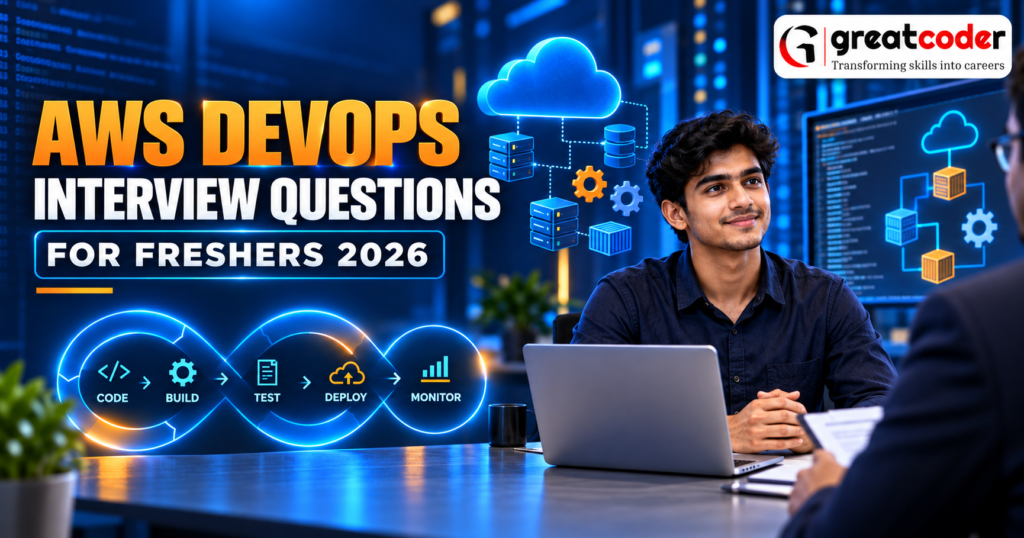
AWS DevOps Interview Questions are essential for freshers preparing for cloud and DevOps roles in 2026. Interviewers commonly evaluate candidates on AWS services, Linux, Git, CI/CD, Docker, Jenkins, Terraform, monitoring, security, and deployment strategies.
Companies today want to release applications faster without compromising reliability or security. AWS DevOps helps organizations achieve this by combining development practices, operations, automation, monitoring, and cloud services.
If you are preparing for an entry-level AWS DevOps role in 2026, interviewers may test your understanding of AWS fundamentals, Linux, Git, CI/CD, Docker, Infrastructure as Code, monitoring, networking, and deployment strategies.
This guide covers frequently asked AWS DevOps interview questions for freshers, along with straightforward answers and preparation tips.
What Is AWS DevOps?
AWS DevOps is the practice of applying DevOps principles using Amazon Web Services and related automation tools.
It helps development and operations teams collaborate throughout the software lifecycle. Learn how these practices are covered in our DevSecOps with Multi-Cloud and AI Enabled course.
Some frequently used AWS DevOps services include AWS CodePipeline, CodeBuild, CodeDeploy, CloudFormation and CloudWatch. You can also explore the top DevSecOps tools for 2026 to understand the broader automation and security toolset.
- AWS CodePipeline
- AWS CodeBuild
- AWS CodeDeploy
- AWS CloudFormation
- Amazon EC2
- Amazon ECS
- Amazon EKS
- Amazon CloudWatch
- AWS Identity and Access Management
- AWS Systems Manager
According to AWS documentation, CodePipeline can model and automate software release stages, while CodeBuild compiles source code, runs tests, and creates deployment-ready artifacts. AWS CodePipeline documentation, AWS CodeBuild documentation
AWS DevOps Interview Questions and Answers for Freshers
1. What is DevOps?
DevOps is a combination of culture, practices, and tools that improves collaboration between software development and IT operations teams.
Its primary objectives are to:
- Shorten the software development lifecycle
- Automate repetitive processes
- release software more frequently
- Improve application reliability
- Detect and resolve problems faster
- Maintain consistent development and production environments
DevOps is not a single tool or job title. It is an approach that combines collaboration, automation, continuous improvement, and shared responsibility.
2. What is the difference between Agile and DevOps?
Agile focuses mainly on improving software development through short and iterative development cycles.
DevOps extends this approach to application testing, delivery, deployment, infrastructure management, monitoring, and operations.
In simple terms, Agile helps teams develop software faster, while DevOps helps teams develop, release, operate, and improve software continuously.
3. What are the different stages of the DevOps lifecycle?
A typical DevOps lifecycle includes:
- Planning
- Development
- Code integration
- Building
- Testing
- Deployment
- Operations
- Monitoring
- Feedback and improvement
These stages form a continuous cycle instead of a one-time process.
4. What is continuous integration?
Continuous Integration, or CI, is a practice in which developers frequently merge their code changes into a shared repository.
Every change can automatically trigger processes such as:
- Code compilation
- Unit testing
- Code-quality analysis
- Security scanning
- Artifact creation
CI helps teams identify integration errors early.
5. What is continuous delivery?
Continuous delivery ensures that an application is always in a deployable state.
After code passes the required build and testing stages, it is prepared for release. Deploying it to production may still require manual approval.
6. What is continuous deployment?
Continuous deployment automatically releases every approved code change to production after it successfully passes all pipeline stages.
The main difference is that continuous delivery may require manual production approval, whereas continuous deployment releases changes automatically.
AWS Cloud Interview Questions
7. What is Amazon EC2?
Amazon Elastic Compute Cloud, or EC2, provides virtual servers in the AWS cloud.
Users can select the required operating system, processor, memory, storage, networking configuration, and security settings. DevOps engineers commonly use EC2 instances for application hosting, build agents, testing environments, and self-managed tools.
8. What is an Amazon Machine Image?
An Amazon Machine Image, or AMI, is a template used to launch EC2 instances.
It may contain:
- An operating system
- Installed software
- Application packages
- Configuration settings
- Launch permissions
A team can create a custom AMI to launch multiple servers with a consistent configuration.
9. What is Amazon S3?
Amazon Simple Storage Service is an object-storage service.
In DevOps projects, S3 can be used to store:
- Application artifacts
- Build packages
- Log files
- Backups
- Static website files
- CloudFormation templates
- CodeDeploy revisions
S3 stores information as objects inside buckets.
10. What is IAM in AWS?
AWS Identity and Access Management helps control authentication and authorization for AWS resources.
Important IAM components include:
- Users
- Groups
- Roles
- Policies
- Permissions
A DevOps engineer should follow the principle of least privilege, which means granting only the permissions required to perform a task.
11. What is the difference between an IAM user and an IAM role?
An IAM user generally represents a person or application that requires long-term access credentials.
An IAM role provides temporary permissions that can be assumed by users, applications, AWS services, or external identities.
For example, an EC2 instance can assume an IAM role to access an S3 bucket without storing permanent access keys on the server.
12. What is a VPC?
An Amazon Virtual Private Cloud is a logically isolated network created within AWS.
A VPC may contain:
- Public and private subnets
- Route tables
- Internet gateways
- NAT gateways
- Security groups
- Network access control lists
A typical application may place a load balancer in public subnets and application or database resources in private subnets.
13. What is the difference between a security group and a network ACL?
A security group controls traffic at the resource or network-interface level. It is stateful, which means response traffic is automatically allowed for an approved connection.
A network ACL operates at the subnet level. It is stateless, so inbound and outbound rules must be evaluated separately.
Security groups support allow rules, while network ACLs can support both allow and deny rules.
14. What are Elastic Load Balancing and Auto Scaling?
Elastic Load Balancing distributes incoming traffic across multiple targets, such as EC2 instances, containers, or IP addresses.
EC2 Auto Scaling adjusts the number of instances according to demand, configured schedules, health checks, or scaling policies.
Together, they help improve availability, performance, and fault tolerance.
CI/CD Interview Questions for Freshers
15. What is AWS CodePipeline?
AWS CodePipeline is a continuous delivery service that automates the stages involved in releasing software.
A pipeline may contain:
- Source stage
- Build stage
- Test stage
- Approval stage
- Deployment stage
When source code changes, CodePipeline can move that change through the configured release workflow automatically.
16. What is AWS CodeBuild?
AWS CodeBuild is a managed build service that compiles source code, runs tests, and creates deployable artifacts.
Build instructions are commonly defined in a buildspec.yml file. Because AWS manages the build infrastructure, teams do not have to maintain their own build servers.
17. What is AWS CodeDeploy?
AWS CodeDeploy automates application deployments to EC2 instances, on-premises servers, AWS Lambda functions, and Amazon ECS services. It supports deployment approaches designed to reduce manual effort and application downtime. AWS CodeDeploy documentation
18. What is an AppSpec file?
An AppSpec file tells CodeDeploy how to deploy an application.
Depending on the deployment platform, it may specify:
- Source and destination files
- Deployment lifecycle hooks
- Scripts to run
- Lambda function versions
- ECS task definitions
- Traffic-routing configuration
The file is commonly named appspec.yml or appspec.json.
19. Explain a simple AWS CI/CD pipeline.
A basic pipeline may work as follows:
- A developer pushes code to a Git repository.
- The source change triggers CodePipeline.
- CodeBuild installs dependencies and runs tests.
- CodeBuild creates a deployable artifact.
- The artifact is stored in an S3 bucket.
- CodeDeploy releases the application to EC2 or ECS.
- CloudWatch monitors logs, metrics, and alarms.
- The team rolls back the deployment if health checks fail.
20. What is Jenkins?
Jenkins is an open-source automation server widely used for CI/CD.
It can automate:
- Application builds
- Testing
- Security checks
- Docker image creation
- Infrastructure deployment
- Application releases
A Jenkins Pipeline is commonly defined through a Jenkinsfile stored with the application code.
21. What is the difference between Jenkins and AWS CodePipeline?
Jenkins is highly customizable and supports an extensive plugin ecosystem, but teams may need to install, secure, patch, and scale the Jenkins infrastructure.
CodePipeline is an AWS-managed continuous delivery service with native integrations across AWS.
The appropriate option depends on an organization’s existing tools, customization requirements, cloud environment, and maintenance strategy.
Infrastructure as Code Interview Questions
22. What is Infrastructure as Code?
Infrastructure as Code, or IaC, is the practice of defining and managing infrastructure through machine-readable configuration files.
Instead of creating resources manually, teams describe the required infrastructure as code.
Benefits include:
- Repeatable environments
- Version control
- Faster provisioning
- Fewer manual errors
- Easier review and auditing
- Simplified disaster recovery
23. What is AWS CloudFormation?
AWS CloudFormation helps users define and provision AWS infrastructure through templates.
The template describes resources such as EC2 instances, load balancers, databases, and security groups. CloudFormation then provisions and configures those resources as a stack. AWS CloudFormation documentation
24. What is Terraform?
Terraform is an Infrastructure as Code tool developed by HashiCorp.
It uses declarative configuration files to provision resources across AWS and many other providers.
The usual Terraform workflow includes:
terraform init
terraform plan
terraform apply
The state file records the relationship between the configuration and managed infrastructure. Because this file may contain sensitive information, teams should protect it and use secure remote-state storage for collaborative environments.
25. What is configuration drift?
Configuration drift occurs when the actual infrastructure differs from its approved or declared configuration.
For example, if an engineer manually changes a security group created through Infrastructure as Code, the deployed environment may no longer match its template.
Drift detection, controlled change processes, version control, and automated deployments help reduce this problem.
Docker and Container Interview Questions
26. What is Docker?
Docker is a platform for packaging an application and its dependencies into a container image.
Containers help applications run consistently across development, testing, and production environments.
27. What is the difference between a Docker image and a container?
A Docker image is an immutable template containing the application, runtime, libraries, and configuration required to run it.
A container is a running or stopped instance of that image.
One image can be used to create multiple containers.
28. What is a Dockerfile?
A Dockerfile is a text file containing instructions for building a Docker image.
Common instructions include:
- FROM – selects the base image
- WORKDIR – sets the working directory
- COPY – copies files into the image
- RUN – executes build commands
- EXPOSE – documents the application port
- CMD – defines the default startup command
29. What is Amazon ECR?
Amazon Elastic Container Registry is a managed container-image registry.
A CI/CD pipeline can build a Docker image, scan or test it, push it to ECR, and deploy it to Amazon ECS or Amazon EKS.
30. What is the difference between Amazon ECS and Amazon EKS?
Amazon ECS is AWS’s container-orchestration service with deep integration into the AWS ecosystem.
Amazon EKS is a managed Kubernetes service.
ECS can be simpler for teams working mainly within AWS, while EKS is useful when Kubernetes compatibility, Kubernetes tooling, or portable orchestration skills are required.
Monitoring and Troubleshooting Questions
31. What is Amazon CloudWatch?
Amazon CloudWatch is a monitoring and observability service for AWS resources and applications.
It can collect and work with:
- Metrics
- Logs
- Alarms
- Dashboards
- Application telemetry
- Events and operational data
A team can configure an alarm to notify operators or trigger an automated action when a metric crosses a defined threshold. Amazon CloudWatch documentation
32. What is the difference between metrics, logs, and alarms?
Metrics are numerical measurements collected over time, such as CPU utilization, request count, or latency.
Logs are timestamped records produced by applications, operating systems, and AWS services.
Alarms evaluate metrics and perform actions when predefined conditions are met.
33. How would you troubleshoot a failed deployment?
A fresher can explain the process systematically:
- Check the pipeline stage that failed.
- Read build and deployment logs.
- Verify the application artifact.
- Check environment variables and configuration files.
- Review IAM permissions.
- Confirm network connectivity and security-group rules.
- Examine application health checks.
- Compare the deployment with the previous successful version.
- Roll back if production stability is affected.
- Document the root cause and prevention steps.
Interviewers usually value a structured troubleshooting approach more than random tool commands.
Scenario-Based AWS DevOps Interview Questions
34. A website becomes slow during peak traffic. What would you check?
I would examine CloudWatch metrics for CPU usage, memory, request count, latency, error rate, database performance, and load-balancer target health.
I would also verify whether Auto Scaling policies are configured correctly and check application logs for slow queries or failed external requests.
35. A developer accidentally committed an AWS access key. What should be done?
The exposed credential should be disabled or deleted immediately. The team should investigate its usage, review audit logs, rotate affected credentials, and remove the secret from the repository history where appropriate.
The application should use IAM roles or a managed secrets solution instead of hard-coded credentials.
36. How would you minimize downtime during deployment?
Possible methods include:
- Blue/green deployment
- Rolling deployment
- Canary release
- Load-balancer health checks
- Automated testing
- Monitoring and alarms
- A documented rollback process
In a blue/green deployment, the new application version is prepared separately before traffic is redirected to it, making rollback easier if the new version fails.
37. What would you do if a pipeline works in development but fails in production?
I would compare:
- Environment variables
- IAM roles and permissions
- Network configuration
- Service limits
- Application dependencies
- Secrets and certificates
- Resource names
- Operating-system or runtime versions
- Production logs
The objective is to identify configuration differences and then bring environments under consistent, version-controlled management.
How Freshers Can Prepare for an AWS DevOps Interview
Build a Practical Project
Create a small application and automate its deployment.
A suitable fresher project could include:
- Source code stored in Git
- Application packaged with Docker
- Image stored in Amazon ECR
- Automated build and test stages
- Deployment to EC2 or ECS
- Infrastructure created with Terraform or CloudFormation
- Logs and alarms configured in CloudWatch
Explain the Project Clearly
Be ready to explain:
- The problem you solved
- Why you selected each tool
- How code moves through the pipeline
- How secrets are protected
- How failures are identified
- How a deployment can be rolled back
Mention Real Challenges
Discuss genuine problems you encountered, such as an IAM permission error, failed health check, incorrect port mapping, missing environment variable, or Docker build failure.
Use the STAR Method
Structure project answers using Situation, Task, Action, and Result. This helps you present practical experience clearly even when you have not yet worked in a full-time DevOps role.
Frequently Asked Questions
Is AWS DevOps suitable for freshers in 2026?
Yes. Freshers can begin with Linux, networking, Git, AWS fundamentals, scripting, Docker, CI/CD, and Infrastructure as Code. Practical projects are essential for demonstrating job readiness.
Is coding compulsory for an AWS DevOps role?
Advanced application development is not mandatory for every entry-level position. However, basic scripting knowledge in Bash or Python is valuable for automation, troubleshooting, and pipeline tasks.
Which AWS services should freshers learn first?
Start with IAM, EC2, S3, VPC, Elastic Load Balancing, Auto Scaling, CloudWatch, CodePipeline, CodeBuild, CodeDeploy, ECR, ECS, and CloudFormation.
Should freshers learn Jenkins or AWS CodePipeline?
Learning both is beneficial. Jenkins develops broader CI/CD knowledge, while CodePipeline helps candidates understand AWS-native release automation.
Is an AWS certification enough to get a DevOps job?
A certification can validate foundational knowledge, but it does not replace practical ability. Candidates should combine certification preparation with hands-on projects, troubleshooting practice, GitHub documentation, and mock interviews.
What should I include in an AWS DevOps fresher resume?
Include relevant cloud and DevOps skills, certifications, internships, GitHub links, and two or three practical projects. Greatcoder also provides placement support that includes resume preparation, mock interviews and career guidance.
Conclusion
AWS DevOps interviews for freshers in 2026 are likely to evaluate both conceptual understanding and practical problem-solving.
Do not prepare only by memorizing definitions. Build a working project that uses Git, CI/CD, AWS infrastructure, containers, monitoring, and secure access management. Practice explaining how each component works, why you selected it, and how you would troubleshoot a failure.
A strong foundation in Linux, networking, AWS, Git, Docker, Jenkins or CodePipeline, Terraform or CloudFormation, and CloudWatch can help you approach entry-level interviews with confidence.
Greatcoder Trainings offers practical DevSecOps with AIOps, GitOps & Multi-Cloud training with hands-on labs, real-time projects, interview preparation, and placement support.
Explore our DevSecOps with Multi-Cloud and AI Enabled course or book a free demo class at Greatcoder Trainings, Madhapur.