
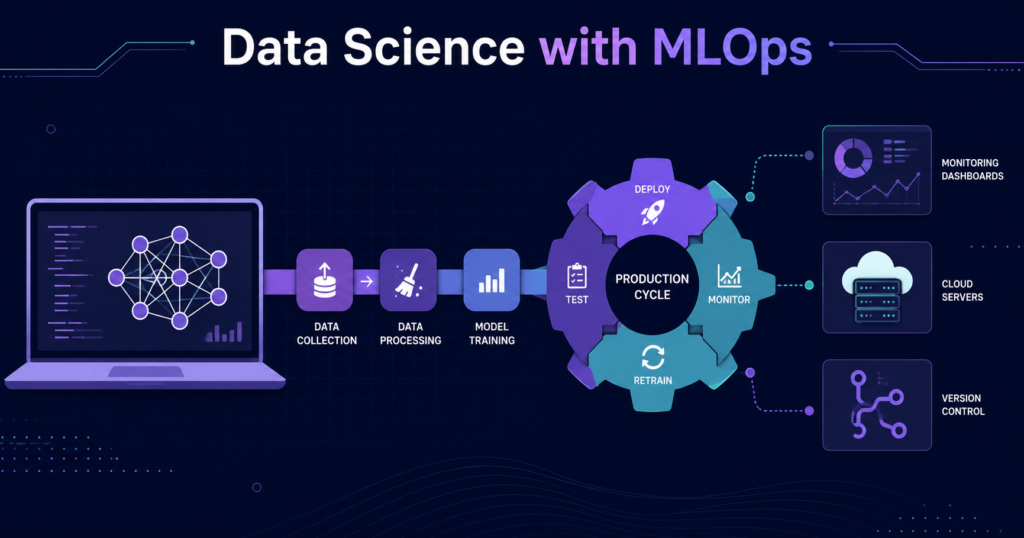
Data Science with MLOps is one of the most in-demand career paths in 2026. By combining data science, machine learning, and MLOps practices, professionals can build, deploy, monitor, and scale AI models efficiently in production environments.
The first kind builds models in a notebook, hands them to someone else to deploy, and rarely touches what happens after that. The second kind knows how to take that same model and actually run it reliably in production monitored, versioned, and automatically retrained when it starts to drift. That second skill set has a name: MLOps.
According to multiple 2026 salary reports, data scientists with hands-on MLOps, GenAI, and LLM skills earn 25–40% more than generalist data scientists with the same years of experience. This guide explains exactly what Data Science with MLOps means, why it commands a premium in Hyderabad’s job market, and the specific Machine Learning Operations Career Roadmap to build this career from scratch.
What Is Data Science with MLOps?
MLOps (Machine Learning Operations) is the practice of taking a machine learning model from a data scientist’s laptop and running it reliably in a real production system the same way DevOps does for regular software applications.
Building a model that predicts customer churn with 92% accuracy is one skill. Making sure that model keeps working correctly six months later, when customer behavior has changed, traffic has tripled, and the model needs to be retrained without breaking the live application that is MLOps. Think of it this way: a data scientist is like a chef who creates an excellent new recipe. MLOps is the entire kitchen operation that lets a restaurant serve that exact recipe correctly to a thousand customers a day, every day, consistently and replaces the recipe smoothly when a better one is created.
Why Data Science with MLOps Alone Is No Longer Enough
For years, “data scientist” meant someone who could clean data, build models in Jupyter notebooks, and present insights. That role still exists but it now sits at the lower end of the salary band.
The shift happened because companies realized that 80% of machine learning projects in the past never reached production. Models stayed as proof-of-concepts because nobody owned the job of deploying, monitoring, and maintaining them reliably. MLOps emerged to solve exactly this gap.
In 2026, a two-tier salary structure has clearly formed in India:
- Traditional data scientists working on standard ML models, dashboards, and reporting earn one salary band.
- AI-specialized data scientists with MLOps, GenAI, and LLM deployment skills earn 25–40% more at equivalent experience levels.
This is not a small gap. It is the single biggest controllable factor in your data science salary trajectory in 2026.
Data Science and MLOps Salary in Hyderabad (2026)
Here is what the current market actually pays, based on 2026 salary data from Glassdoor, AmbitionBox, and Levels.fyi:
| Role | Experience | Salary Range (Hyderabad) |
| Data Scientist (Generalist) | 0-2 years | ₹6–10 LPA |
| Data Scientist (Generalist) | 2-5 years | ₹12–19 LPA |
| Data Scientist (MLOps skills) | 2-5 years | ₹16–24 LPA |
| MLOps Engineer | 0-2 years | ₹6–10 LPA |
| MLOps Engineer | 2-5 years | ₹12–18 LPA |
| MLOps Engineer | 5+ years | ₹20–28 LPA |
| Senior / Lead Data Scientist | 5+ years | ₹25–35 LPA |
Hyderabad consistently ranks among India’s top three cities for data science and MLOps hiring, alongside Bangalore and Mumbai driven by a strong base of IT companies, GCCs (Global Capability Centers), and growing AI startups in HITEC City and Gachibowli.
The Skills That Actually Drive This Salary Premium
Based on 2026 hiring data, here are the specific skill categories that separate the higher-paying tier from the generalist tier:
1. Model Deployment and Serving
Knowing how to package a trained model and serve it through an API using tools like Flask, FastAPI, or cloud-native services so other applications can actually use its predictions in real time.
2. MLOps Pipeline Tools
Hands-on experience with MLflow for experiment tracking and model versioning, Kubeflow or Airflow for orchestrating ML pipelines, and DVC (Data Version Control) for versioning datasets alongside code.
3. Containerization and Orchestration
Docker and Kubernetes are no longer optional for data scientists who want to move into the higher salary tier. Models need to run inside containers to be deployed consistently across environments this is where DevOps and data science skill sets directly overlap.
4. Model Monitoring and Drift Detection
Once a model is live, its accuracy degrades over time as real-world data shifts away from the training data this is called model drift. Knowing how to set up monitoring (using tools like Evidently AI or Prometheus + Grafana) to detect this automatically is a premium, in-demand skill.
5. Cloud ML Platforms
Practical experience with AWS SageMaker, Azure Machine Learning, or Google Vertex AI the managed platforms that most companies now use to train and deploy models at scale, rather than managing infrastructure manually.
6. GenAI and LLM Deployment
In 2026, this is the single highest-value skill category. Knowing how to fine-tune, deploy, and serve large language models including techniques like RAG (Retrieval-Augmented Generation) and prompt engineering at scale commands the steepest salary premium of any data science specialization.
Data Science vs MLOps vs ML Engineer: What Is the Difference?
These three roles are frequently confused, even by hiring managers. Here is a clear breakdown:
| Role | Primary Focus | Typical Background |
| Data Scientist | Building models, statistical analysis, generating business insights | Statistics, Python, SQL |
| ML Engineer | Building scalable ML systems, writing production-grade model code | Software engineering + ML |
| MLOps Engineer | Deploying, monitoring, and maintaining ML systems in production | DevOps + ML fundamentals |
In practice, these lines are blurring fast. The most highly paid professionals in 2026 are the ones who can operate comfortably across all three building a model, writing production-ready code for it, and understanding how it will be deployed and monitored.
Step-by-Step Roadmap: Data Science with MLOps in 2026
Step 1: Foundation (Weeks 1–6)
Build a solid base in Python, SQL, and statistics. Learn Pandas and NumPy for data manipulation, and get comfortable with exploratory data analysis. Without this foundation, everything that follows will be shaky.
Step 2: Core Machine Learning (Weeks 7–14)
Learn supervised and unsupervised learning algorithms, model evaluation metrics, and feature engineering. Build 3–4 real projects not just following tutorials, but working with messy, real-world datasets from Kaggle or government open data portals.
Step 3: Deep Learning Basics (Weeks 15–20)
Get comfortable with TensorFlow or PyTorch. Understand neural networks, and build at least one deep learning project image classification or a basic NLP task works well as a starting point.
Step 4: Data Science with MLOps Fundamentals (Weeks 21–28)
This is where most data science courses stop and where your real differentiation begins. Learn:
- Git and version control for ML projects (including DVC for data versioning)
- Docker for containerizing models
- MLflow for experiment tracking
- Building a basic CI/CD pipeline that automatically tests and deploys a model
Step 5: Cloud and Production Deployment (Weeks 29–34)
Deploy a real model to AWS SageMaker or a similar cloud platform. Learn how to expose it through an API, set up basic monitoring, and understand how autoscaling works for ML workloads in production.
Step 6: GenAI and LLM Specialization (Weeks 35+)
Once the fundamentals are solid, specialize in GenAI fine-tuning open-source LLMs, building RAG pipelines, and understanding prompt engineering at a production level. This is where the highest 2026 salary premiums are concentrated.
Common Mistakes Aspiring Data Scientists Make
- Only doing Kaggle competitions and never deploying anything. Kaggle builds modeling skills but teaches nothing about production systems. Recruiters increasingly ask: “Have you deployed a model that real users interacted with?”
- Skipping the DevOps fundamentals entirely. Treating MLOps as optional rather than core. In 2026, this is the single biggest reason talented data scientists plateau in the lower salary band.
- Focusing only on model accuracy. A 95% accurate model that takes 8 seconds to respond and crashes under load is worse than a 90% accurate model that responds instantly and reliably. Production thinking matters as much as model quality.
- Ignoring monitoring after deployment. Many beginners think the job ends at deployment. In reality, ongoing monitoring for drift and performance degradation is where senior-level expertise is demonstrated.
Why This Matters for Your Career in Hyderabad Specifically
Hyderabad’s tech ecosystem has grown significantly around AI and data, with global capability centers for companies like Microsoft, Amazon, and several Fortune 500 firms actively building data science and ML teams in the city. The cost of living in Hyderabad remains lower than Bangalore or Mumbai, while salaries for skilled MLOps and AI-specialized data scientists remain highly competitive.
This combination strong demand, lower living costs, and a fast-growing AI ecosystem makes Hyderabad one of the best cities in India right now to build a Data Science with MLOps career.
Frequently Asked Questions
Do I need a background in software engineering to learn MLOps?
No, but it helps. Many successful MLOps engineers come from data science or even DevOps backgrounds and pick up the missing half along the way. What matters most is comfort with Python, basic Linux commands, and a willingness to learn Docker and cloud platforms.
Is MLOps a separate job, or a skill within data science?
Both, depending on the company. Larger companies often hire dedicated MLOps Engineers who work closely with data science teams. Smaller companies and startups frequently expect data scientists to own deployment and monitoring themselves which is exactly why MLOps skills increase a data scientist’s salary.
How long does it take to become job-ready in Data Science with MLOps?
With consistent, hands-on practice of 3-4 hours per day, most learners reach an interview-ready level in 7-8 months, covering the full roadmap from foundations through MLOps and cloud deployment. Those with a prior background in programming or statistics often reach this point in 5-6 months.
Which is better to learn first: traditional data science or MLOps?
Traditional data science fundamentals first. You cannot operationalize a model you do not understand how to build. MLOps builds on top of solid modeling skills trying to learn deployment before understanding the model itself leads to gaps that show up quickly in interviews.
Is the 25-40% MLOps salary premium real, or is it marketing?
It is real and consistently reported across multiple 2026 salary platforms including Glassdoor, AmbitionBox, and Levels.fyi. The premium exists because very few data scientists have genuine, demonstrable production deployment experience making this combination of skills genuinely scarce in the current job market.
Conclusion
Data Science with MLOps is not a trend it is where the entire field has been heading for several years, and 2026 is the year the salary data makes that shift undeniable. The data scientists earning ₹20L+ in Hyderabad today are not necessarily the ones who can build the most accurate model. They are the ones who can take that model from a notebook to a live, monitored, reliable production system.
If you are starting your data science journey now, build MLOps into your learning path from day one rather than treating it as an advanced topic to revisit later. The roadmap in this guide foundations, core ML, deep learning, MLOps fundamentals, cloud deployment, and GenAI specialization reflects exactly what Hyderabad’s top-paying roles expect in 2026.
Want to learn Data Science with MLOps through structured, hands-on training with real cloud lab access? GreatCoder’s Data Science with MLOps program covers this entire roadmap with placement support for eligible students in Hyderabad. Book a free demo class to see if it is the right fit for you.
Learn More: Docker Documentation
Kubernetes Documentation