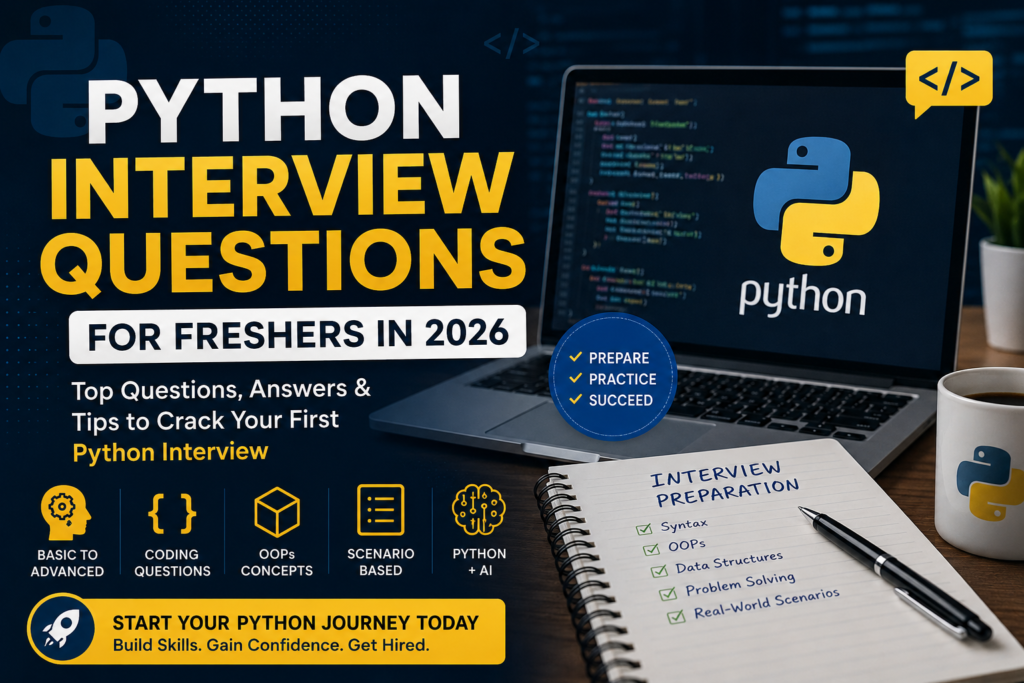
Python Interview Questions for Freshers 2026 are designed to help beginners and aspiring Python developers prepare for technical interviews with confidence. Whether you are applying for your first Python developer role, a software development position, or an entry-level AI-related job, understanding Python fundamentals, OOP, coding problems, data structures, and practical scenarios is essential. If you are looking to build practical Python development skills, explore our Python Full Stack with AI course.
But preparing for a Python interview is not about memorizing a long list of questions.
Interviewers often test whether you understand Python fundamentals, object-oriented programming, data structures, coding logic, debugging, and real-world problem-solving.
In 2026, candidates may also encounter questions connecting Python with AI, machine learning, APIs, automation, and data processing.
This guide covers the major categories of Python interview questions for freshers in 2026, with simple explanations and practical examples.
Basic Python Interview Questions
1. What is Python?
Python is a high-level, general-purpose programming language known for its readable syntax and extensive ecosystem.
It is commonly used for:
- Web development
- Automation
- Data analysis
- Artificial intelligence
- Machine learning
- Scripting
- Backend development
- Testing
2. What are the main features of Python?
Some important features include:
- Simple and readable syntax
- Dynamic typing
- Object-oriented programming support
- Large standard library
- Cross-platform compatibility
- Automatic memory management
- Large third-party package ecosystem
3. What are Python’s built-in data types?
Common built-in types include:
int, float, complex, str, list, tuple, set, dict, bool, and NoneType.
4. What is the difference between == and is?
== compares values, while is checks whether two references point to the same object.
a = [1, 2]
b = [1, 2]
print(a == b) # True
print(a is b) # False
5. What is the difference between mutable and immutable objects?
Mutable objects can be changed after creation. Lists, dictionaries, and sets are examples.
Immutable objects cannot be changed after creation. Strings, integers, floats, and tuples are common examples.
6. What are Python variables?
A variable is a name that refers to an object.
name = “Rahul”
age = 22
Python does not require you to explicitly declare the variable’s data type.
7. What is indentation in Python?
Indentation defines blocks of code in Python.
if age >= 18:
print(“Eligible”)
Incorrect indentation can cause an IndentationError.
Python OOP Interview Questions
Object-oriented programming is an important topic for Python interviews because many real-world applications are built using classes and objects.
8. What is OOP in Python?
Object-oriented programming organizes software around objects that contain data and behavior.
The major OOP concepts are:
- Encapsulation
- Inheritance
- Polymorphism
- Abstraction
9. What is a class?
A class is a blueprint for creating objects.
class Student:
def __init__(self, name):
self.name = name
10. What is an object?
An object is an instance of a class.
student = Student(“Rahul”)
Here, student is an object of the Student class.
11. What is inheritance?
Inheritance allows one class to reuse attributes and methods from another class.
class Animal:
def speak(self):
print(“Animal speaks”)
class Dog(Animal):
pass
Dog inherits from Animal.
12. What is polymorphism?
Polymorphism allows the same interface or method name to behave differently depending on the object using it.
13. What is encapsulation?
Encapsulation involves grouping data and methods together and controlling how internal data is accessed or modified.
14. What is self in Python?
self refers to the current instance of a class.
class Student:
def show(self):
print(self)
15. What is __init__()?
__init__() is commonly used to initialize an object’s attributes when an instance is created.
class Student:
def __init__(self, name):
self.name = name
Python Coding Interview Questions
Coding questions test whether you can apply Python concepts to solve problems.
16. How do you reverse a string in Python?
text = “Python”
print(text[::-1])
Output:
nohtyP
17. How do you check whether a number is even or odd?
number = 10
if number % 2 == 0:
print(“Even”)
else:
print(“Odd”)
18. How do you check whether a string is a palindrome?
text = “madam”
if text == text[::-1]:
print(“Palindrome”)
else:
print(“Not a palindrome”)
19. How do you find the largest number in a list?
numbers = [10, 25, 7, 40, 15]
print(max(numbers))
In an interview, you may also be asked to solve this without using max(). Practice both approaches.
20. How do you count the frequency of characters in a string?
A dictionary can be used to store each character and its count.
text = “python”
frequency = {}
for char in text:
frequency[char] = frequency.get(char, 0) + 1
print(frequency)
21. How do you remove duplicates from a list?
For a simple case:
numbers = [1, 2, 2, 3, 3, 4]
unique = list(set(numbers))
If the original order must be preserved, use a different approach rather than relying on a set alone.
Python Interview Questions for Beginners
Beginners should be comfortable with basic programming concepts before moving into advanced Python topics.
22. What is a loop in Python?
A loop executes a block of code repeatedly.
Python commonly uses:
- for
- while
Example:
for number in range(5):
print(number)
23. What is the difference between break, continue, and pass?
break exits the loop.
continue skips the current iteration.
pass performs no action and is commonly used as a placeholder.
24. What is a function?
A function is a reusable block of code.
def greet(name):
return “Hello ” + name
25. What is a lambda function?
A lambda is a small anonymous function.
square = lambda x: x * x
print(square(5))
26. What is exception handling?
Exception handling allows programs to respond to runtime errors.
try:
result = 10 / 0
except ZeroDivisionError:
print(“Cannot divide by zero”)
27. What is a module?
A module is a Python file containing reusable code such as functions, classes, and variables.
import math
print(math.sqrt(25))
Scenario-Based Python Interview Questions
This section is important because interviews often move beyond definitions and ask how you would handle a practical problem.
28. What would you do if your Python program is running slowly?
First, identify where the performance problem occurs rather than changing code randomly.
You could:
- Profile the application.
- Identify slow functions or operations.
- Check inefficient loops and data structures.
- Reduce unnecessary calculations.
- Optimize database or API calls.
- Consider caching where appropriate.
29. How would you handle invalid user input?
Validate the input and use exception handling where appropriate.
try:
age = int(input(“Enter your age: “))
except ValueError:
print(“Please enter a valid number.”)
30. What would you do if an API suddenly starts returning errors?
Check the HTTP status code, response body, request parameters, authentication, rate limits, and API documentation.
Do not immediately assume the Python code is the problem.
31. How would you debug a Python program?
A good approach is:
Reproduce → isolate → inspect → fix → test.
Use clear logging, debugging tools, test cases, and error messages instead of changing multiple things at once.
Python Interview Questions on Lists, Tuples and Dictionaries
32. What is the difference between a list and tuple?
A list is mutable:
numbers = [1, 2, 3]
A tuple is immutable:
numbers = (1, 2, 3)
33. What is a dictionary?
A dictionary stores data using key-value pairs.
student = {
“name”: “Rahul”,
“age”: 22
}
34. Why are dictionaries useful?
Dictionaries provide a convenient way to associate keys with values and are widely used for structured data, configuration, lookup operations, and counting.
35. What is list comprehension?
List comprehension provides a concise way to create a list.
squares = [x * x for x in range(5)]
36. When should you use a tuple instead of a list?
Use a tuple when the collection represents data that should not be modified after creation.
For example:
coordinates = (17.385, 78.486)
Python + AI Interview Questions for Freshers
This section gives the article a more relevant 2026 angle. Python is heavily used in AI and machine learning because of its libraries, developer ecosystem, and ease of experimentation. Freshers interested in building AI-powered applications can also explore Python Full Stack with AI training.
37. Why is Python widely used in AI?
Python provides a large ecosystem of libraries and frameworks used for data processing, machine learning, deep learning, and AI application development.
Examples include:
- NumPy
- Pandas
- Scikit-learn
- PyTorch
- TensorFlow
38. How is Python used in generative AI?
Python can be used to build applications that interact with generative AI models through APIs or frameworks.
For example, a Python application could:
- Receive user input.
- Send the input to an AI model.
- Process the response.
- Display or store the result.
39. What Python skills are useful for AI jobs?
Freshers interested in AI should understand:
- Python fundamentals
- Functions
- Object-oriented programming
- Lists and dictionaries
- APIs
- JSON
- Data processing
- Basic mathematics
- NumPy
- Pandas
- Machine learning fundamentals
40. How can Python connect to an AI API?
A Python application can send HTTP requests to an AI service using an API client or HTTP library.
A typical workflow is:
Python Application → API Request → AI Model → API Response → Python Application
41. What is the difference between traditional Python development and AI-based Python development?
Traditional Python development may focus on application logic, APIs, automation, and backend systems.
AI-based development often adds components such as:
- Model APIs
- Machine learning models
- Data pipelines
- Embeddings
- Vector databases
- Prompt processing
- Evaluation
Freshers do not necessarily need to master every AI technology before applying for Python roles. Strong Python fundamentals should come first.
Frequently Asked Python Interview Questions for Freshers 2026
Is Python difficult for freshers?
Python is relatively beginner-friendly, but programming logic still requires practice. Learning syntax alone will not make you interview-ready.
What Python topics should a fresher learn?
Start with:
- Variables
- Data types
- Operators
- Conditions
- Loops
- Functions
- Strings
- Lists
- Tuples
- Sets
- Dictionaries
- Exception handling
- OOP
- Modules
- Basic coding problems
Are coding questions asked in Python interviews?
Yes. Entry-level interviews commonly include coding exercises involving strings, numbers, lists, dictionaries, loops, and basic algorithms.
Is Python enough to get a job?
Python is an important skill, but most developer roles require additional knowledge. Depending on the job, learn SQL, Git, APIs, a Python framework, testing, and basic deployment concepts.
How should I prepare for Python Interview Questions for Freshers 2026?
Learn core Python first and then add AI-related skills such as APIs, data processing, machine learning basics, and AI application development.
Tips to Crack Your First Python Interview
1. Do Not Memorize Answers
Interviewers can quickly identify candidates who have memorized definitions without understanding them.
Learn the concept and practice explaining it in your own words.
2. Practice Coding Every Day
Even 30 to 60 minutes of consistent coding can improve your problem-solving ability.
Focus on small problems before attempting complex algorithms.
3. Understand Your Projects
If Python projects appear on your resume, expect questions about them.
Be ready to explain:
- What problem the project solved
- Why you selected Python
- Your responsibilities
- Technologies used
- Challenges faced
- How you handled errors
- What you would improve
4. Practice Explaining Your Logic
Do not immediately start writing code.
First understand the problem, explain your approach, then write the solution.
5. Learn the Fundamentals Before AI
AI is a valuable addition in 2026, but weak Python fundamentals will still hurt you in a Python interview.
Build the foundation first.
6. Practice Mock Interviews
Mock interviews help you improve technical communication, coding speed, and confidence.
7. Prepare for Follow-Up Questions
If an interviewer asks you to reverse a string, they may follow up with:
“Can you do it without slicing?”
or:
“What is the time complexity?”
Prepare for variations, not just the original question.
Conclusion
Preparing for Python Interview Questions for Freshers 2026 requires more than memorizing answers.
You need a combination of Python fundamentals, coding practice, OOP knowledge, data structures, problem-solving ability, and practical understanding.
The addition of Python + AI is also useful for candidates preparing for modern technology roles. However, AI should complement your Python foundation, not replace it.
Start with the basics, solve coding problems regularly, build practical projects, and practice explaining your solutions clearly. Looking for structured IT training? Explore our IT courses in Hyderabad.
The strongest fresher candidate is not necessarily the person who knows the most Python syntax. It is the candidate who can understand a problem, develop a logical solution, write clean code, explain the approach, and adapt when the interviewer changes the requirements. Ready to start your Python career? Enroll in Python training today.