
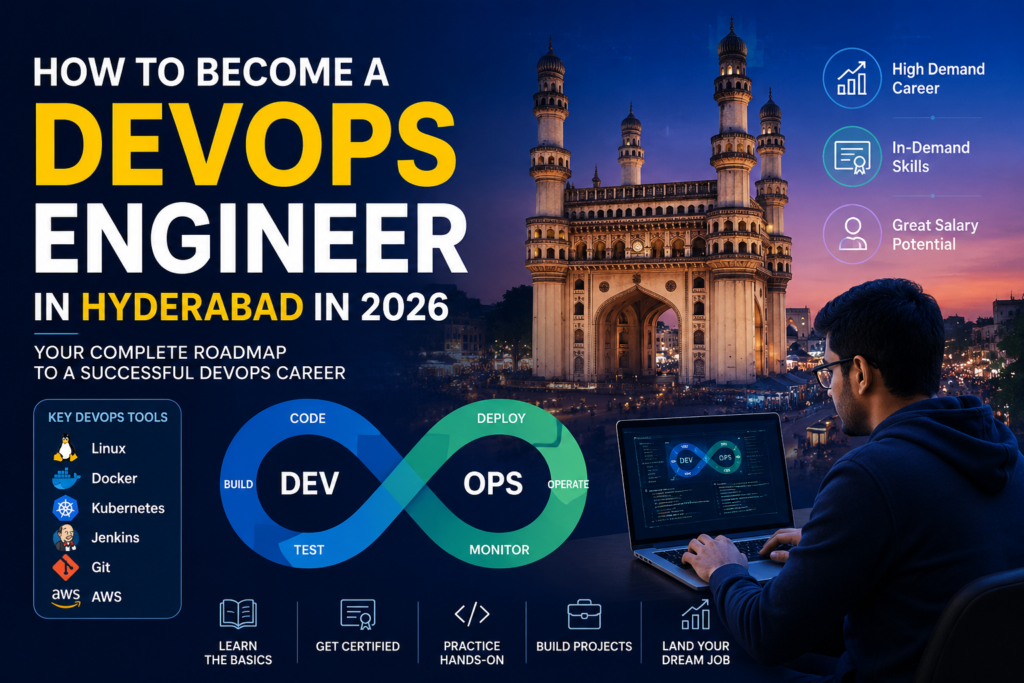
If you are looking for the most in-demand IT career in Hyderabad right now, the answer is DevOps. With over 14,000 active job listings on Naukri and LinkedIn for DevOps and cloud roles in Hyderabad alone, 2026 is the best year to make this career move -whether you are a fresher, a career switcher from a non-IT background, or a working professional stuck in manual testing or support roles.
In this guide, you will get a complete, step-by-step roadmap to become a DevOps engineer in Hyderabad – what skills to learn, in what order, how long it realistically takes, what salary to expect, and exactly how to get your first job. No fluff. No generic advice. Only what actually works in the Hyderabad IT market in 2026.
What is DevOps – and Why 2026 is Different
DevOps is a combination of development and operations practices that allows software teams to build, test, and deploy applications faster and more reliably. Instead of developers writing code and throwing it over the wall to an operations team, DevOps engineers automate the entire pipeline – from code commit to production deployment.
But DevOps in 2026 is not the same as DevOps in 2020. Three major shifts have changed what the job actually requires:
• Security is now built into the pipeline (DevSecOps) – companies no longer treat security as a final step before release. Tools like SonarQube, OWASP ZAP, and Vault are now standard in every CI/CD pipeline.
• Multi-cloud is the norm – most Hyderabad MNCs run workloads on AWS and Azure simultaneously. Knowing only one cloud platform limits your opportunities significantly.
• AI tools are part of the job – engineers use GitHub Copilot to write Terraform code, AWS CodeWhisperer for Lambda functions, and AI-assisted monitoring tools. This is not optional anymore.
The good news: Hyderabad is one of the top three cities in India for DevOps hiring. HITEC City, Gachibowli, Kondapur, and Madhapur together house hundreds of companies – from TCS and Wipro to fast-growing startups – all actively hiring DevOps and cloud engineers in 2026.
DevOps Engineer Salary in Hyderabad 2026
Before you invest time and money in learning, it makes sense to understand what this career actually pays. Here is a realistic salary breakdown based on current job postings in Hyderabad:
| Experience | Role | Salary (Hyderabad) | Demand |
| 0–1 year | Junior DevOps | ₹4–6 LPA | High |
| 2–4 years | DevOps Engineer | ₹8–14 LPA | Very High |
| 5+ years | Senior / Lead DevOps | ₹18–30 LPA | Critical |
| 3+ years | DevSecOps Engineer | ₹10–18 LPA | Fastest Growing |
To put this in perspective: a manual software tester with 3 years of experience typically earns ₹4–6 LPA in Hyderabad. A DevOps engineer with the same 3 years earns ₹10–14 LPA. That is the career switch opportunity in plain numbers.
DevSecOps engineers earn 20–30% more than standard DevOps engineers because they combine infrastructure skills with security knowledge – one of the rarest and most in-demand profiles in Hyderabad right now.
Step-by-Step Roadmap to Become a DevOps Engineer in 2026
Here is the exact sequence you should follow. Do not skip steps – each one builds the foundation for the next.
Step 1: Linux and Scripting Foundation (Weeks 1-4)
Every DevOps role requires Linux. Before you touch Docker, Kubernetes, or any cloud platform, you need to be comfortable on the Linux command line. This is non-negotiable.
• Linux administration: file system, permissions, processes, cron jobs, systemd
• Bash scripting: write scripts to automate repetitive tasks – this comes up in every DevOps interview
• Python for DevOps: boto3 for AWS automation, paramiko for SSH, simple automation scripts
• Git: branching strategy, merge vs rebase, resolving conflicts – interviewers ask this constantly
Step 2: CI/CD Pipeline Engineering (Weeks 5–8)
CI/CD (Continuous Integration and Continuous Deployment) is the core of the DevOps job. You need to understand how code moves from a developer’s laptop to production automatically.
• Jenkins: create pipelines from scratch, understand stages, agents, and shared libraries
• GitHub Actions: the modern alternative to Jenkins – increasingly preferred by Hyderabad companies in 2026
• GitLab CI/CD: standard in enterprise MNCs – TCS, Wipro, Cognizant all use this
• Build a real project: set up a full CI/CD pipeline for a sample Python or Java application
Step 3: Containers and Kubernetes (Weeks 9–14)
This is the section that separates a basic DevOps engineer from one who gets offers at ₹10L+. Kubernetes is the most in-demand DevOps skill in Hyderabad job listings in 2026.
• Docker: write Dockerfiles, multi-stage builds, Docker Compose for local development
• Kubernetes architecture: understand pods, deployments, services, ConfigMaps, ingress controllers
• Helm charts: package and deploy applications using Helm – standard in production environments
• Real project: Dockerize a Python web application and deploy it on a Kubernetes cluster (even minikube locally counts)
Step 4: Cloud Platform – Start with AWS (Weeks 10–18)
Start with AWS. It powers approximately 60% of DevOps job requirements in Hyderabad. Once you are confident with AWS, add Azure or GCP for multi-cloud roles that pay significantly more.
• AWS core services: EC2, VPC, S3, IAM, Lambda, EKS, RDS, CloudWatch, Route 53
• AWS Cloud Practitioner certification: takes 2–3 weeks, adds credibility immediately to your resume
• Azure DevOps: Azure Pipelines and AKS are standard in several Hyderabad MNCs
• GCP basics: GKE (Google Kubernetes Engine) – worth knowing for product companies and startups
Step 5: Infrastructure as Code and Security (Weeks 16–22)
This is the step that unlocks the ₹10L+ salary range. Knowing how to write infrastructure as code and integrate security into pipelines is what distinguishes junior DevOps from senior DevOps.
• Terraform: provision AWS/Azure infrastructure with code, manage state, use modules and workspaces
• Ansible: automate server configuration, write playbooks and roles – still widely used in Hyderabad enterprises
• DevSecOps: integrate SonarQube (SAST) and OWASP ZAP (DAST) into Jenkins/GitHub Actions pipelines
• Secrets management: HashiCorp Vault and AWS Secrets Manager – interviewers at senior DevOps levels always ask this
Tools Every DevOps Engineer Must Know in 2026
You do not need to master all of these before applying for your first role. The priority sequence: Docker → Kubernetes → Jenkins or GitHub Actions → AWS → Terraform. Add the rest as you grow.
| Tool | Category | Why you need it |
| Docker | Containers | Package apps into portable containers – every DevOps job requires this |
| Kubernetes | Orchestration | Manage Docker containers at scale – the #1 skill in Hyderabad JDs |
| Jenkins / GitHub Actions | CI/CD | Automate build, test, deploy pipelines – must-know for interviews |
| Terraform | IaC | Provision cloud infra with code – replaces manual console clicking |
| Ansible | Automation | Configure servers automatically – saves hours of manual work |
| AWS / Azure / GCP | Cloud | Start with AWS, add Azure/GCP later for multi-cloud roles |
| SonarQube + OWASP ZAP | Security | SAST and DAST tools – essential for DevSecOps roles |
| Prometheus + Grafana | Monitoring | Observe system health – every production role uses these |
| GitHub Copilot | AI Tools | Write Terraform, Bash, and YAML faster with AI assistance |
AI tools like GitHub Copilot are now part of the standard DevOps toolkit in 2026. Engineers who can use AI to write Terraform configurations, generate Kubernetes manifests, and debug pipeline scripts get work done 2x faster – and hiring managers notice.
How Long Does It Actually Take?
Here is an honest answer based on students who went through this process in Hyderabad:
- Fresher with no IT background: 5-6 months with 3-4 hours of focused study per day
- IT professional switching from development or testing: 3-4 months
- Working professional studying evenings and weekends: 6-8 months
The key is not just watching videos or reading tutorials. You must build real projects that go on your GitHub profile. Interviewers at TCS Digital, Wipro, and Mphasis routinely ask candidates to walk through their GitHub repositories during technical rounds.
Be skeptical of any course or training that promises ‘Become a DevOps engineer in 30 days.’ The fundamentals – especially Linux, Kubernetes, and Terraform – require time to genuinely understand. Shortcuts here cost you in interviews.
Best Way to Learn DevOps in Hyderabad – Online vs Offline vs Structured Training
There are three realistic options, and each has a genuine trade-off:
Self-learning (YouTube + Udemy)
• Cost: Low (₹500–2,000 for courses)
• Flexibility: Complete control over pace
• Challenge: No structured path, no hands-on lab environment, no guidance when stuck, no placement support
• Reality: Most self-learners plateau at Docker and never reach Kubernetes + Terraform level without guidance
Offline classroom training in Hyderabad
• Structure: Defined curriculum and schedule
• Challenge: Fixed timings are difficult for working professionals; lab access limited to classroom hours
• Cost: ₹30,000–60,000 for a full DevOps program
Live online instructor-led training with labs and placement support
• Best of both worlds: live classes with a working professional, flexible morning/evening/weekend batches
• Lab access: Practice on real AWS sandbox environment – no extra cloud billing during training
• Placement support: Resume building, LinkedIn profile, GitHub portfolio, mock interviews, hiring partner connections
• This is the model Greatcoder uses for its DevSecOps with Multi-Cloud AI program in Hyderabad
What to look for in any DevOps program before enrolling: live classes (not recorded videos), real cloud lab access included, instructors with active industry experience, and a placement track record you can verify by speaking to past students.
Real Story: From Manual Tester to DevOps Engineer in 4 Months
Rahul, a BSc Computer Science graduate from Hyderabad, spent two years as a manual QA tester earning ₹3.4 LPA. He had tried learning DevOps from YouTube for six months but kept getting stuck at Kubernetes and Terraform. He joined GreatCoder’s structured DevSecOps program in August 2025.
By November 2025 – four months later – he had completed the program, built a GitHub portfolio with three real projects including a CI/CD pipeline on AWS EKS, and cleared technical rounds at Wipro and Mphasis. He accepted an offer from Wipro as a Cloud DevOps Engineer at ₹7.2 LPA.
The salary jump from ₹3.4L to ₹7.2L in four months is not unusual for candidates who go through structured, project-based training with active placement support. The difference is not talent – it is having the right structure and the right guidance.
“The mock interviews were the game-changer for me. I had the knowledge but did not know how to present it in an interview. After three rounds of mock interviews with Greatcoder mentors, I cleared the Wipro technical round on the first attempt.” – Rahul K., Cloud DevOps Engineer, Wipro Hyderabad
Frequently Asked Questions
Is DevOps a good career for freshers in Hyderabad?
Yes – if you build the right skills and projects. Hyderabad companies hire freshers into junior DevOps and cloud support roles actively. You do not need prior work experience, but you need a GitHub portfolio with real projects and at least the AWS Cloud Practitioner certification.
What is the minimum qualification to become a DevOps engineer?
Any engineering degree (B.Tech, BE) or science degree (BSc, MCA) works. Many of the best DevOps engineers in Hyderabad switched from mechanical engineering, civil engineering, or non-IT backgrounds. Skills matter more than your degree – but you need to be able to demonstrate them.
Which cloud should I learn first – AWS, Azure, or GCP?
Start with AWS. Approximately 60% of DevOps job requirements in Hyderabad mention AWS specifically. Once you are confident with AWS, add Azure (required by most MNCs) and GCP basics. Knowing all three is what unlocks multi-cloud roles at ₹15L+.
Can I get a DevOps job without any prior IT experience?
Yes. What matters is: (1) the skills – Linux, Docker, Kubernetes, CI/CD, AWS; (2) a strong GitHub portfolio showing real projects; (3) AWS Cloud Practitioner or AWS Solutions Architect Associate certification; and (4) strong mock interview preparation. Background does not matter if these four elements are in place.
What is the difference between DevOps and DevSecOps?
DevOps focuses on automation, CI/CD, and infrastructure. DevSecOps adds security integration – SAST, DAST, container security scanning, and secrets management – directly into the DevOps pipeline. DevSecOps roles pay 20–30% more and are among the fastest-growing positions in Hyderabad in 2026.
Conclusion – Your Next Step
The path to becoming a DevOps engineer in Hyderabad in 2026 is clear: start with Linux and scripting, build up through CI/CD and Kubernetes, add cloud (AWS first), and finish with Terraform and DevSecOps security tools. Dedicate 3-4 hours per day, build real projects on GitHub, and get mock interview practice.
Hyderabad remains one of India’s top three cities for DevOps hiring – with salaries from ₹7L for freshers to ₹25L+ for experienced engineers. The demand is real, the salary jump is real, and the path is clear.
If you want a structured program with real AWS lab access, working professional mentors, and a placement track record you can verify, check out Greatcoder DevSecOps with Multi-Cloud AI program. Book a free demo class at thegreatcoder.com – no commitment, no cost, just one class to see if it is the right fit for you.