
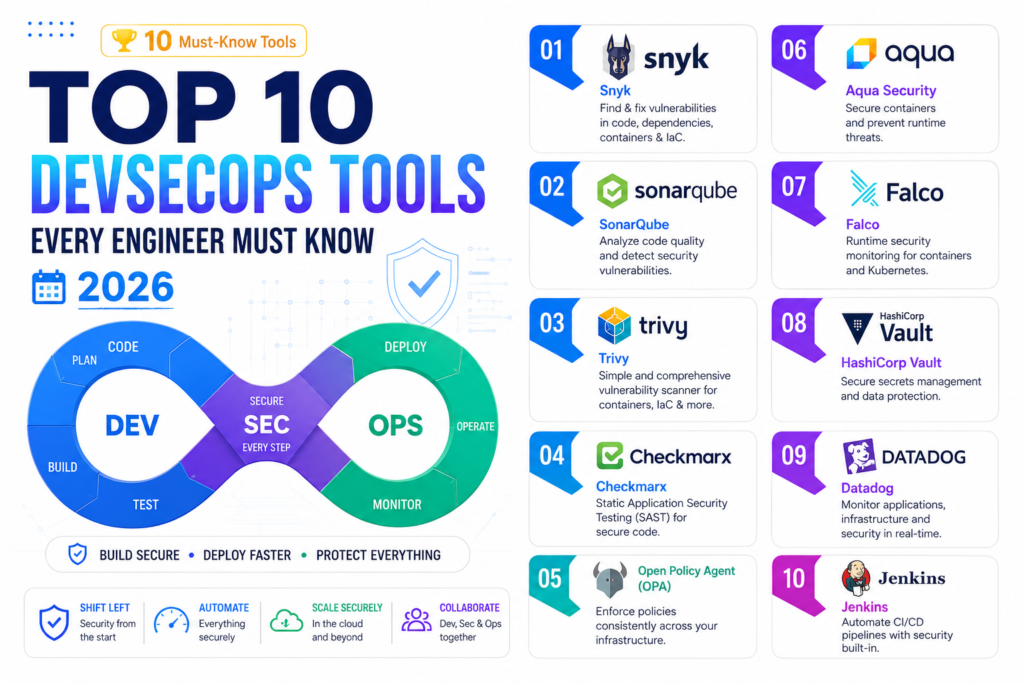
If you want to become a DevSecOps engineer in Hyderabad in 2026, knowing the theory is not enough. Recruiters at TCS, Wipro, Mphasis, and fast-growing startups in HITEC City ask one question in technical interviews: what tools have you actually worked with?
DevSecOps combines Development, Security, and Operations into a single automated pipeline. The tools that make this pipeline work are specific – and learning the right ones in the right order determines whether you get placed or keep waiting.
This guide covers the top 10 DevSecOps tools that appear most frequently in Hyderabad job descriptions in 2026. For each tool: what it does in plain language, why it matters for your career, and how it fits into the Hyderabad job market specifically.
Note: You do not need all 10 tools before applying for jobs. Start with Tools 01-04 (Docker, Kubernetes, Jenkins or GitHub Actions, Terraform) – these four alone qualify you for junior to mid-level DevOps roles. Add tools 05-06 (SonarQube, OWASP ZAP) for DevSecOps-specific positions that pay 20-30% more.
The Top 10 DevSecOps Tools Explained
1. Docker
Docker packages an application and all its dependencies into a lightweight, portable container that runs identically on any machine or server. Before Docker, the classic problem was “it works on my machine but crashes in production.” Docker eliminates this entirely by making the environment part of the application itself.
Why it matters: Every DevSecOps pipeline starts with containers. Docker is the prerequisite before Kubernetes, CI/CD pipelines, and cloud deployment. You cannot skip this step.
Hyderabad job market: Docker appears in over 78% of DevOps job descriptions on Naukri for Hyderabad roles in 2026. It is the single most demanded hands-on skill across TCS, Wipro, Mphasis, and HITEC City startups.
2. Kubernetes
Kubernetes (K8s) manages Docker containers at scale. When you have 50 containers running across multiple servers, Kubernetes handles deployment, scaling, load balancing, self-healing, and rolling updates automatically – without manual work. If one container crashes, Kubernetes restarts it immediately.
Why it matters: Docker runs containers. Kubernetes manages them in production at scale. Senior DevOps roles almost always require Kubernetes – it is what separates a Rs.6L fresher role from a Rs.14L+ mid-level role in Hyderabad.
Hyderabad job market: Kubernetes is the #1 most-searched DevOps skill in Hyderabad job postings in 2026. AWS EKS, Azure AKS, and GCP GKE are all Kubernetes – meaning this one skill works across all three major cloud platforms.
3. Jenkins / GitHub Actions
Jenkins is the most widely used open-source CI/CD server. GitHub Actions is its modern, cloud-native alternative built directly into GitHub. Both automate the full pipeline from code commit to production deployment – build, test, security scan, and deploy – without a human pressing any buttons. The code goes from laptop to production automatically.
Why it matters: CI/CD is the heart of DevOps. Without a working pipeline, Docker and Kubernetes knowledge stays theoretical. Interviewers almost always ask candidates to explain or walk through a CI/CD pipeline they have personally built.
Hyderabad job market: Jenkins is the standard in Hyderabad MNCs including TCS, Wipro, and Cognizant. GitHub Actions is increasingly preferred by product companies and startups. Knowing both maximises your flexibility across the Hyderabad job market.
4. Terraform
Terraform by HashiCorp lets you define cloud infrastructure – servers, networks, databases, load balancers – as code in .tf files. Instead of clicking through the AWS console manually, you write a configuration file, run terraform apply, and your entire cloud infrastructure is created automatically, repeatably, and consistently.
Why it matters: Terraform is what separates junior DevOps from senior DevOps. Infrastructure as code is versioned, reviewable, and reproducible – it is a premium skill that commands Rs.12L+ salaries in Hyderabad and is a hard requirement for senior cloud roles.
Hyderabad job market: Terraform appears in 60%+ of senior DevOps and Cloud Engineer job descriptions in Hyderabad in 2026. AWS combined with Terraform is the most in-demand skill combination for cloud infrastructure roles.
5. SonarQube
SonarQube scans your source code for security vulnerabilities, bugs, and code quality issues before the code is deployed. It integrates directly into Jenkins and GitHub Actions pipelines, automatically blocking builds that fail security checks. You catch SQL injection, hardcoded credentials, and insecure functions at the code level – before they ever reach production.
Why it matters: This is the “Sec” in DevSecOps. Without SAST, security is tested only after deployment when it is expensive and risky to fix. SonarQube shifts security left, making security a developer and DevOps responsibility – not just the security team.
Hyderabad job market: SonarQube is now a standard requirement for DevSecOps Engineer and Application Security roles across Hyderabad-based IT companies, banks, and healthcare firms. Knowing SonarQube differentiates you from pure DevOps candidates who have no security exposure.
6. OWASP ZAP
OWASP ZAP (Zed Attack Proxy) tests a running web application by simulating real attacks – SQL injection, cross-site scripting (XSS), broken authentication, and more – to find vulnerabilities that only appear when the application is live and processing real requests. Unlike SonarQube which scans source code, ZAP tests the deployed application in action.
Why it matters: SAST and DAST together form a complete security layer. SonarQube catches code-level vulnerabilities. OWASP ZAP catches runtime vulnerabilities. DevSecOps engineers need both – and most candidates know only one, making this knowledge a real differentiator.
Hyderabad job market: DevSecOps roles at Hyderabad-based BFSI (banking and finance) and healthcare companies increasingly list OWASP ZAP as a required or preferred skill. It is often the differentiating factor between two otherwise equal candidates at interview stage.
7. Ansible
Ansible automates server configuration, software installation, and application deployment using simple YAML files called playbooks. Instead of SSH-ing into 50 servers and manually installing packages one by one, you write one playbook and Ansible handles all 50 servers simultaneously – and idempotently, meaning running it twice gives the same result.
Why it matters: Terraform provisions infrastructure. Ansible configures it. They are complementary, not competing tools. Ansible is also widely used for application deployment in enterprise environments that have not yet fully adopted Kubernetes.
Hyderabad job market: Ansible remains heavily used in Hyderabad MNCs and government IT projects where Kubernetes adoption is still in progress. It is a practical requirement for enterprise-focused DevOps roles at Infosys, HCL, and Wipro Hyderabad offices.
8. Prometheus + Grafana
Prometheus is an open-source monitoring system that collects real-time metrics from applications and infrastructure – CPU usage, memory, request latency, error rates, pod restarts. Grafana visualises those metrics in interactive dashboards. Together they give DevOps engineers complete production visibility and enable alerting when metrics breach defined thresholds.
Why it matters: Deploying an application is 50% of the job. The other 50% is knowing when it is failing and why, before users notice. Prometheus and Grafana are the industry-standard observability stack for Kubernetes environments in 2026.
Hyderabad job market: Monitoring skills are listed in almost every senior DevOps and SRE (Site Reliability Engineer) job description in Hyderabad. Any company running Kubernetes in production needs engineers who can set up and interpret Prometheus metrics and Grafana dashboards.
9. HashiCorp Vault
HashiCorp Vault securely stores and manages sensitive information – API keys, database passwords, SSL certificates, SSH credentials – and provides dynamic secrets that automatically expire after use. Without Vault, secrets end up hardcoded in application code, environment files, or accidentally committed to Git repositories – one of the most common real-world security breaches.
Why it matters: Hardcoded secrets in code are one of the most common root causes of security incidents. DevSecOps engineers are responsible for ensuring secrets never appear in source code, CI/CD pipeline logs, or container images. Vault is the enterprise-standard solution for this.
Hyderabad job market: Vault expertise is increasingly required for senior DevSecOps roles at Hyderabad-based financial services, healthcare IT, and enterprise companies. AWS Secrets Manager is the cloud-native alternative – knowing either or both significantly strengthens your profile for security-focused roles.
10. GitHub Copilot (AI DevOps Tools)
GitHub Copilot uses AI to generate code, Terraform configurations, Kubernetes YAML manifests, Bash scripts, and Dockerfile content from plain English prompts. DevOps engineers who use AI tools complete infrastructure tasks 2-3x faster. AWS CodeWhisperer and Google Gemini Code Assist offer similar capabilities. The engineers who use these tools are not being replaced – they are replacing the engineers who do not.
Why it matters: AI tools are no longer optional in 2026. They are part of the standard DevOps toolkit. Engineers who use AI to write infrastructure code, debug pipeline failures, and generate security test cases have a measurable and growing productivity advantage in every team.
Hyderabad job market: Hiring managers at Hyderabad tech companies increasingly ask in interviews: “Do you use AI tools in your daily workflow?” The expected answer in 2026 is yes. GitHub Copilot is free for students and significantly discounted for working professionals.
How to Learn These Tools – In the Right Order
The sequence matters. Trying to learn Kubernetes before Docker, or Vault before Terraform, is like learning to drive on a motorway before understanding the gears. Here is the correct learning sequence for Hyderabad job market readiness.
| Phase | Tools | What you can do after this phase |
| Weeks 1-4 | Linux + Git + Docker | Build containerised apps. Apply for junior DevOps and cloud support roles at Rs.4-6L. |
| Weeks 5-10 | Jenkins + GitHub Actions | Build full CI/CD pipelines from scratch. Demonstrate real automation in interviews. |
| Weeks 11-16 | Kubernetes + Terraform + AWS | Deploy to cloud at scale. Qualify for mid-level DevOps and Cloud Engineer roles at Rs.8-14L. |
| Weeks 17-22 | SonarQube + OWASP ZAP + Vault | Add security to pipelines. Apply for DevSecOps Engineer roles at Rs.10-18L+. |
| Weeks 23+ | Prometheus + Grafana + Copilot | Handle production monitoring and AI-assisted workflows. Senior and Lead DevOps roles. |
Frequently Asked Questions
Which DevSecOps tool should I learn first?
Docker. Without containers, none of the other tools in this list make sense in practice. Docker is the foundation – once you understand how to containerise an application, everything else follows: Kubernetes for orchestration, Jenkins for CI/CD, cloud platforms for deployment.
Do I need to know all 10 tools to get a DevOps job?
No. For a fresher or junior DevOps role (Rs.4-7L), employers typically expect Docker, basic Kubernetes, and one CI/CD tool. For a mid-level DevOps role (Rs.8-14L), add Terraform and AWS. The full DevSecOps toolkit including SonarQube, OWASP ZAP, and Vault is expected for senior and security-focused roles.
Is DevSecOps different from DevOps?
DevSecOps is an evolution of DevOps that integrates security testing directly into the CI/CD pipeline rather than treating it as a final step. A DevOps engineer builds and deploys software faster. A DevSecOps engineer does the same and also ensures security vulnerabilities are caught before deployment. DevSecOps roles pay 20-30% more than equivalent DevOps roles in Hyderabad.
Are these tools free to learn?
Yes. Docker Desktop is free for personal use. Kubernetes runs locally via Minikube at no cost. Jenkins is fully open-source. Terraform CLI is free. SonarQube Community Edition is open-source. OWASP ZAP is completely free. Prometheus and Grafana are open-source. GitHub Actions is free for public repositories. GitHub Copilot is free for students.
How long does it take to be job-ready in DevSecOps?
With 3-4 hours of hands-on practice per day – not just watching tutorials but actually building and pushing projects to GitHub – most candidates are interview-ready in 5-6 months. Career switchers from development or testing backgrounds typically reach that point in 3-4 months.
Conclusion
DevSecOps is not about knowing every tool. It is about understanding how they connect: Docker packages the app, Kubernetes runs it at scale, Jenkins automates the pipeline, Terraform provisions the cloud, SonarQube and OWASP ZAP secure it, Vault protects the secrets, Prometheus and Grafana monitor it, and AI tools accelerate all of it.
Start with Docker today. Build one real containerised project. Push it to GitHub. Then add Kubernetes. Then CI/CD. Each step compounds. Six months from now you will have a portfolio that most interviewers in Hyderabad will respect – because most candidates can only talk about these tools rather than demonstrate them.
Want structured training on all 10 tools with real AWS lab access and placement support? GreatCoder’s DevSecOps with Multi-Cloud AI program covers every tool in this list. 100% placement assistance for eligible students. Book a free demo class at thegreatcoder.com/enroll-now